
Indexes Don’t Make Databases Fast
What I learned the hard way is simple. Most read-scaling pain starts with the wrong lookup path, not the wrong database.

If indexing still feels fuzzy, that is not because you are missing something. It is because most explanations either stop at “B-tree fast” or vanish into storage-engine trivia. To be clear, indexing is simpler and harsher than that. You pay extra storage and extra write work so reads stop crawling through data like they are looking for a lost sock.
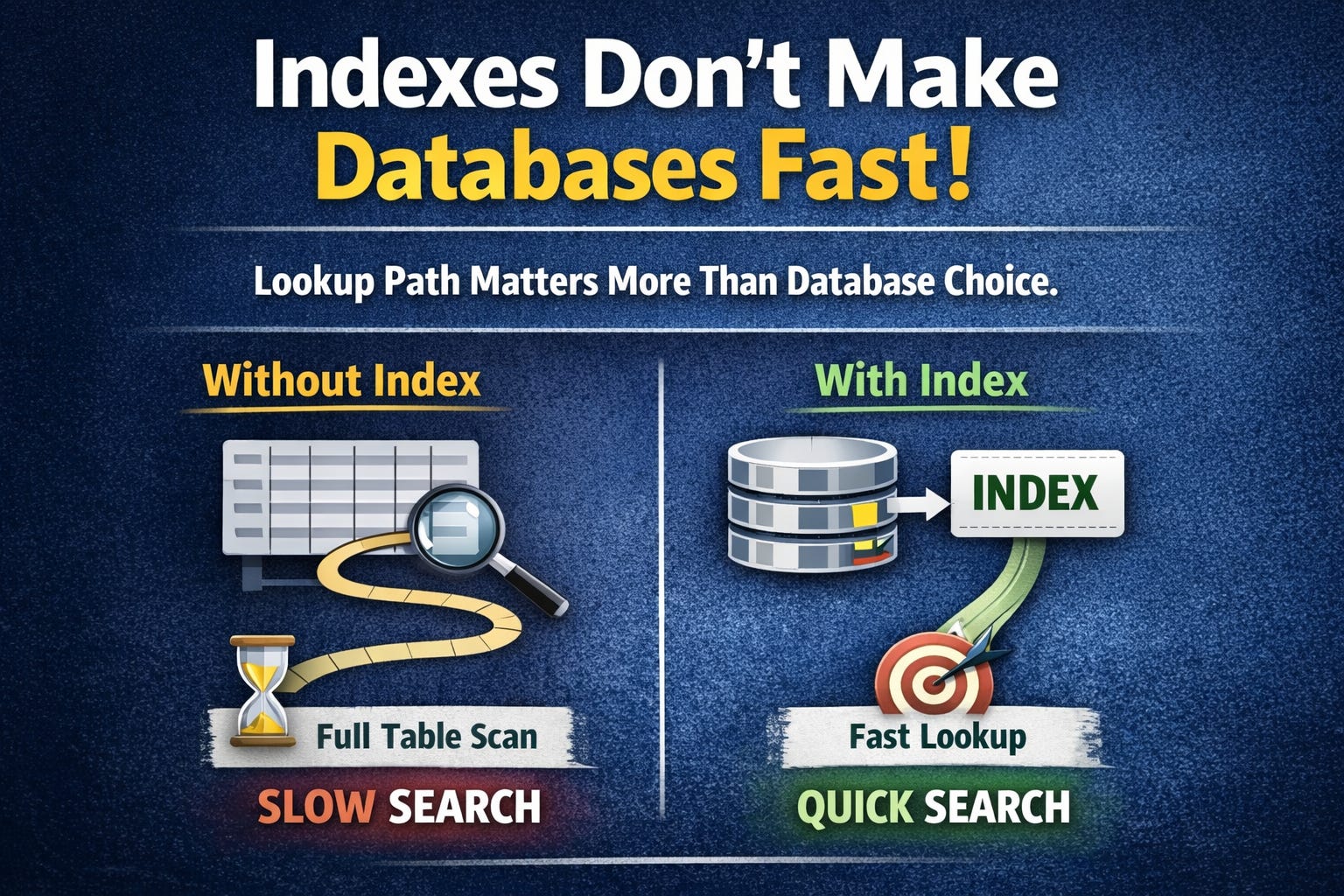
Table of contents
Why indexing exists at all
What really happens without it and with it
The index shapes that matter in practice
Balanced tree
Exact-match hash
Append-first write path
Geo path
Text path
How to choose the right shape for the query you actually have
Composite
Covering
Partial
Expression-based
What changes from local product app to global platform
Where people get fooled
lookup speed
write drag
cross-region freshness
schema drift
FAQ
System Design
To Summarize
What indexing really is
Indexing is a second structure that helps the engine find rows fast without reading the whole table.
The table stores the truth.
The index stores the path to the truth.
In other words, the table is the warehouse and the index is the aisle map. (PostgreSQL)
What happens without it
The engine starts at row 1 and keeps reading until it finds what matches.
As the table grows, the cost grows with it.
Even on SSDs, touching a lot of pages you did not need is still a tax, just a smaller tax than it used to be.
What happens with it
The engine walks the index structure first.
It finds the row location or primary key.
Then it fetches only the target rows it actually needs.
Example
Query
SELECT id, email, status FROM users WHERE email = 'jimmy@x.com'
Without index
full scan
lots of wasted reads
latency grows with table size
With index
targeted lookup
far fewer page reads
latency stays sane much longer
I would recommend saying it like this
“An index is a paid shortcut. We pay on writes and storage so reads stop wandering.” (PostgreSQL)
What this does not mean
It does not fix bad schema.
It does not fix bad query shape.
It does not fix stale cross-region reads.
It does not remove the base-table fetch unless the query can be satisfied from the index alone.
The clean correction
First fix the read path.
Then decide whether indexing is enough or whether you need caching, denormalization, search, or a different storage engine.
An 80M-user login lookup drifts from clean to clumsy and pushes p95 from 30 ms to 1.4 s
Before
Product hears “login is slow.”
Junior hears “add cache.”
Senior hears “show me the query.”
Staff hears “show me
EXPLAIN.”Principal hears “what is the exact read path and where is the waste.”
After
Add the lookup index on the exact filter column.
The query stops dragging cold pages into memory.
CPU drops, IO drops, p95 drops.
I would recommend
Fix the access path before buying bigger machines or spraying cache on a table scan. (MySQL Developer Zone)
[Indexing - the plain version]

[Client query]
      |
      v
[Query planner]
      |
      +--> [No useful index]
      |         |
      |         v
      |   [Scan table pages]
      |         |
      |         v
      |   [Check rows one by one]
      |         |
      |         v
      |   [Filter + sort]
      |         |
      |         v
      |      [Result]
      |
      +--> [Useful index exists]
                |
                v
         [Walk index pages]
                |
                v
     [Find row pointer or PK]
                |
                v
        [Fetch target row]
                |
                v
              [Result]
The shapes that matter
Most teams do not need every exotic option.
Most teams need to understand 5 shapes and stop pretending all read problems are the same.
Balanced tree
This is the default answer most of the time.
It is good for
exact match
range
prefix
ORDER BY
Why it keeps winning
it stays sorted
it stays balanced
it works well for mixed read-write workloads
it is the default in mainstream relational engines for a reason (PostgreSQL)
What this does not mean
It is not the best answer for text meaning, moving geo points, or relentless write firehoses.
The clean correction
Use it when the query is structured, transactional, and repeatable.
Exact-match hash
Good for equality only.
Bad for range and sort.
This is the one-trick specialist.
In practice, it shows up less than people think because the balanced tree is already strong enough for many equality lookups and much more flexible beyond that. (PostgreSQL)
What this does not mean
Faster on paper does not mean better in production.
The clean correction
Use it only when equality is the whole game and nothing else matters.
Append-first write path
This is where write-heavy systems stop behaving like ordinary OLTP tables.
New writes land in memory and an append log first.
Data flushes to immutable disk files later.
Background compaction merges files and removes junk.
Bloom filters help skip files that definitely do not contain the key.
Reads get more complex because the engine may need to check memory plus multiple disk structures.
This trade exists because random in-place updates are expensive when writes are relentless. (Apache Cassandra)
What this does not mean
This is not “just another index type.”
The clean correction
This is a storage-engine choice for write-heavy systems like logs, metrics, clickstream, and large event pipes.
Geo path
Nearby search is not 2 independent 1D filters pretending to be 2D geometry.
A naive
(lat, lng)path can still drag in a huge candidate band or box and then filter later.Better geo paths cluster nearby points first, then apply true-distance filtering at the end.
In-memory geo indexes are often the practical answer when points move frequently. (Redis)
What this does not mean
A composite latitude-longitude index is not the same thing as a real proximity index.
The clean correction
Use a geo-aware path when the product says “near me,” “within 5 miles,” or “closest driver.”
Text path
Once the question becomes “find this word anywhere inside text,” normal structured lookup logic is the wrong shape.
Full-text wants a reverse map from terms to documents.
Tokenization, lowercasing, stop-word removal, stemming, postings lists, and ranking all show up here.
This is why text retrieval lives differently from ordinary equality and range queries. (Google Cloud Documentation)
What this does not mean
LIKE '%term%'is not a grown-up search strategy at scale.
The clean correction
Use a search-style index when the product cares about terms, language, relevance, or phrase matching.
A delivery platform tracks 12M moving points, writes location every few seconds, and “nearby” gets slower exactly when city traffic gets worse
Before
Team forces moving coordinates into a rigid disk-oriented path.
Re-index work rises.
Freshness falls.
Nearby search turns stale under load.
After
Use an in-memory geo path.
Query the center cell plus neighbors.
Filter by true distance at the end.
I would recommend
For constantly moving locations, choose write-friendly geo indexing first or the product starts lying with a straight face. (Redis)
[Index families - what problem they are solving]

[Read pattern]
      |
      +--> [Exact match on scalar]
      |          |
      |          +--> [Balanced tree]
      |          |
      |          +--> [Hash if equality only]
      |
      +--> [Range or ORDER BY]
      |          |
      |          +--> [Balanced tree]
      |
      +--> [Very high write ingestion]
      |          |
      |          +--> [Append-first engine]
      |
      +--> [Nearby points / radius / box]
      |          |
      |          +--> [Geo path]
      |
      +--> [Find words inside text]
                 |
                 +--> [Search / inverted path]
How to choose the shape from the query you actually have
Start from the query, not the table.
Ask
What do I filter on every time?
What do I sort on every time?
What do I return every time?
How fresh does the product actually need this result to be?
Then shape the structure around that path.
Composite
If the query repeats the same multi-column filter and sort, combine those columns in 1 ordered structure.
Example
Query
SELECT order_id, total, created_at FROM orders WHERE customer_id = ? AND status = 'paid' ORDER BY created_at DESC LIMIT 20
Better shape
(customer_id, status, created_at DESC)
Why it works
equality filters first
sort key after
small limit
the engine narrows fast, then returns rows already in the right order
Column order matters.
Prefix matters.
“We indexed all the columns” is not the same as “the query can use the index well.” (PostgreSQL)
What this does not mean
More columns is not automatically better.
The clean correction
Put the repeated equality filters first, then the range or sort dimension that actually matters.
Covering
If the query needs only columns already present in the index, the engine may skip the base-table lookup.
That can be a big win on hot reads with small result payloads.
It can also bloat the index if you get greedy and shove too much into it.
Relational engines support this in different ways, including index-only scans or covering behavior. (PostgreSQL)
What this does not mean
Every hot query deserves a fat covering index.
The clean correction
Use it where the read volume is huge and the projected columns stay small.
Partial
If the hot query only touches a small, repeated slice of rows, index only that slice.
Good examples
only open orders
only failed jobs
only active subscriptions
This keeps the structure smaller and cheaper while directly matching the hot filter. (PostgreSQL)
What this does not mean
Partial is not clever by default.
The clean correction
Use it only when the hot predicate is stable and repeated.
Expression-based
If the query repeatedly computes the same expression, store the retrieval path on that expression.
Good examples
lowercased email
normalized phone
extracted domain
date bucket
What this does not mean
Derived expressions do not save a bad data model.
The clean correction
Use them when the expression is stable, repeated, and product-visible.
Technology fit from local product to global platform
Local to regional product app
balanced read-write workload
predictable relational access
feature set matters
I would recommend the mature relational balanced-tree path
Existing primary-key-heavy stack
most reads are PK-based
operational familiarity matters
I would recommend the clustered primary-key path
Global transactional platform
fresh reads matter across regions
secondary lookup on non-key columns matters too
I would recommend the globally consistent transactional path
Firehose ingest
logs, metrics, clickstream, IoT, audit, telemetry
I would recommend the append-first write-optimized path
To be clear
lookup speed and global freshness are different problems
indexing helps with the first
replication and transaction semantics decide the second (Google Cloud Documentation)
A payout system adds payment_state_v2 mid-flight, Tokyo writes first, Dublin retries second, Virginia reads now, and schema drift turns simple lookups into archaeology while p99 misses 150 ms
Before
New field lands.
Old lookup path still reflects old reality.
Queries slow down or miss the hot path entirely.
Product thinks data is wrong when the path to data is wrong.
After
Add schema.
Backfill safely.
Build the new structure.
Verify with the plan.
Canary by region.
Watch write cost and lag.
I would recommend
Separate 2 questions every time
how fast do I find it
how fresh must it be
The first is a lookup-path question.
The second is a consistency question. (Google Cloud Documentation)
[How to shape the path from the hot query]

[API request]
      |
      v
[Query pattern]
customer_id = ?
status = 'paid'
ORDER BY created_at DESC
LIMIT 20
      |
      v
[Design choice]
Equality filters first
Sort key after
Small result set
      |
      v
[Index shape]
(customer_id, status, created_at DESC)
      |
      v
[Planner]
      |
      v
[Walk to customer + status slice]
      |
      v
[Rows already ordered by time]
      |
      v
[Return top 20]
Why it matters
Because most read pain starts as lookup-path waste, not hardware weakness.
Because every extra structure taxes writes, storage, maintenance, and rollout risk.
Because text, geo, and write firehoses are not side quests. They are different retrieval problems.
Because once you hit real scale, the blast radius is not local.
1 wrong choice can slow writes, widen lock scope, increase lag, and make every region feel slower at once.
Because on some engines, secondary structures also affect commit latency or lock behavior.
Range scans and isolation choices can interact with index ranges and lock gaps.
Additional secondary paths can add commit work.
Because on a 200B-row table, “just add an index” is not a harmless sentence. It is a storage bill, a write tax, and a failure-mode decision. (MySQL Developer Zone)
I would recommend
Treat every production index like a product feature with an owner
query family
latency target
write-cost story
storage story
removal plan
What this does not mean
More indexes is not maturity.
Fewer indexes is not elegance.
The clean correction
The right indexes on the right paths is maturity.
An event ledger hits 200B rows, 40k writes/sec stay hot, 9 teams add their own read convenience, and replica lag turns “data platform” into “data apology”
Before
Every team adds a structure for its dashboard.
Writes slow.
Storage swells.
Lag creeps.
Everyone blames growth.
After
Keep only the serving paths tied to core product reads.
Push text, geo, and analytics into their right lanes.
I would recommend
Under-indexing kills reads.
Over-indexing taxes writes.
The trick is not courage.
It is ownership. (Apache Cassandra)
FAQ
“When should I add an index?”
When the same query repeatedly filters, joins, or sorts on the same fields and that path matters to latency, revenue, or habit.
If the table is tiny or the query is rare, save the ceremony. (MySQL Developer Zone)
“Should I add cache before index?”
I would not.
Cache on top of a table scan is still a table scan wearing cologne.
“What is the safest default?”
Balanced tree.
It handles equality, range, and ordering well and stays the default in mainstream relational engines. (PostgreSQL)
“When do I pick exact-match hash?”
When equality is the whole game and you truly do not care about range or sort.
That is rarer than people make it sound. (PostgreSQL)
“When do I pick the append-first write path?”
When writes dominate so hard that update-in-place becomes the bottleneck.
Think metrics, logs, clickstream, IoT, audit, event firehose. (Apache Cassandra)
“Can a composite
(lat, lng)path solve nearby search?”Better than 2 separate indexes, still not great.
It preserves ordered dimensions, not true 2D locality.
That is why nearby search usually needs a spatial path plus final distance filtering. (Redis)
“How do I handle a 5-mile radius?”
Find the center cell.
Include neighboring cells.
Fetch candidates.
Filter by true distance.
Return the final set.
The approximation gets you close. The distance filter makes it correct. (Redis)
“When do compound indexes help?”
When the query repeatedly uses the same leading filters and sort order.
Prefix order matters.
Wrong order means the planner may shrug and scan anyway. (PostgreSQL)
“When do covering paths help?”
When the query returns only a small set of columns and runs constantly.
Great for small hot reads.
Bad when you bloat every structure trying to be clever. (PostgreSQL)
“Can indexing solve cross-region consistency?”
No.
Indexing solves lookup path.
Consistency is a transaction and replication property. (Google Cloud Documentation)
“How do I handle new fields globally without blowing up reads?”
Add schema.
Backfill.
Build the new structure.
Verify with the plan.
Canary.
Watch write cost, storage cost, and lag.
Then cut over. (Google Cloud Documentation)
“What works at what scale?”
Local to regional product database
the mature balanced-tree relational path is usually the sharpest default
Existing primary-key-centric stack
the clustered primary-key path is fine if the org already runs it well
Global transactional read path with strict freshness
the globally consistent transactional path earns its keep
Write-ingest monsters
the append-first write-optimized path makes more sense than pretending a balanced OLTP engine wants that life (MySQL Developer Zone)
System Design
To Summarize:
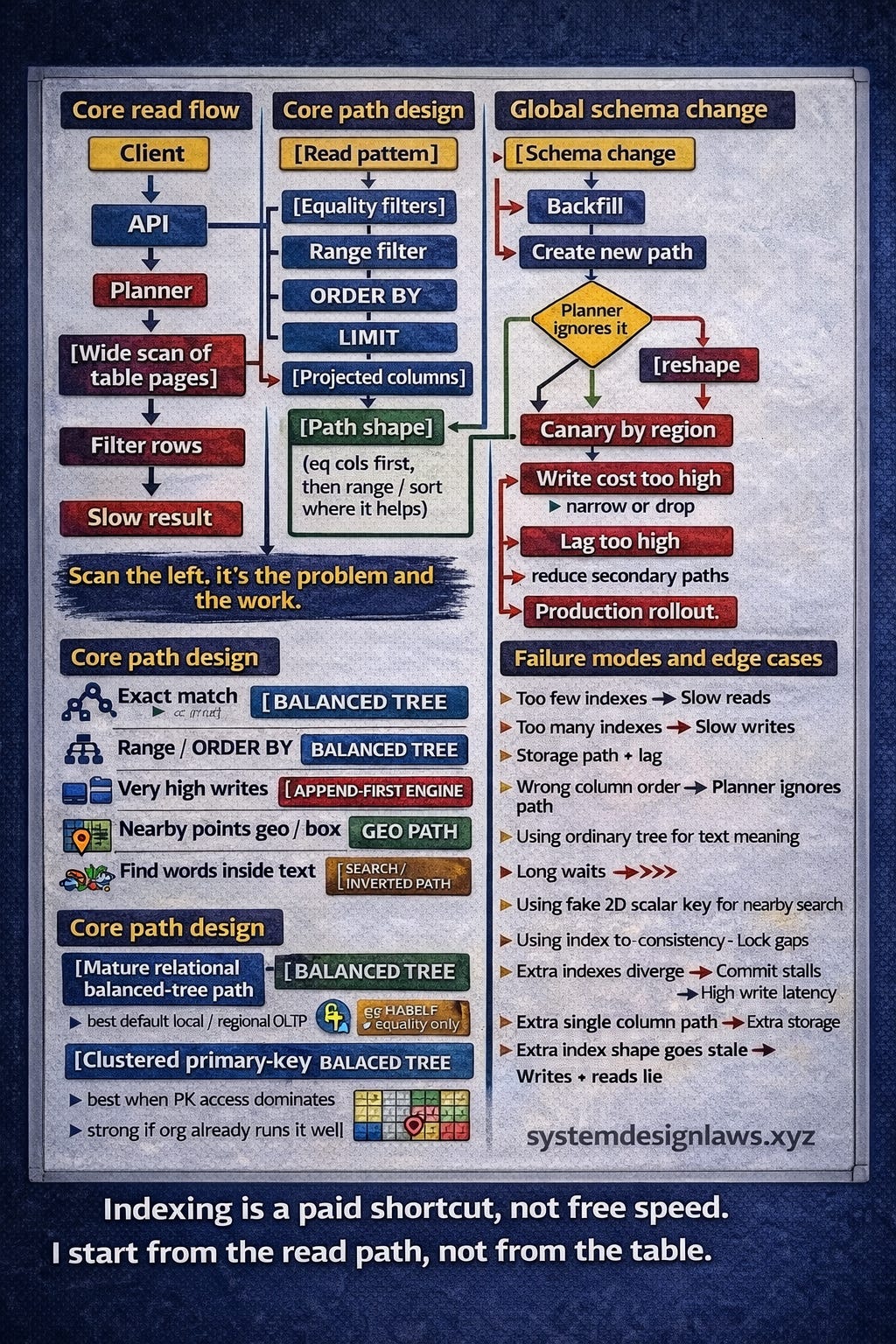
Indexing is a paid shortcut, not free speed.
I start from the read path, not from the table.
For most product queries, the safe default is a balanced ordered path because it handles equality, range, and sort in 1 structure.
When writes dominate, I stop pretending a balanced OLTP path will save me and I move toward an append-first engine.
When the problem is location or text, I use geo or search retrieval because ordinary ordered keys are the wrong shape.
At scale, the real trade is read latency vs write cost vs freshness vs storage.
So the job is not adding indexes. The job is choosing the few that deserve to exist.